TOEFL Reading Practice Test: Beat Distractors with Evidence Mapping

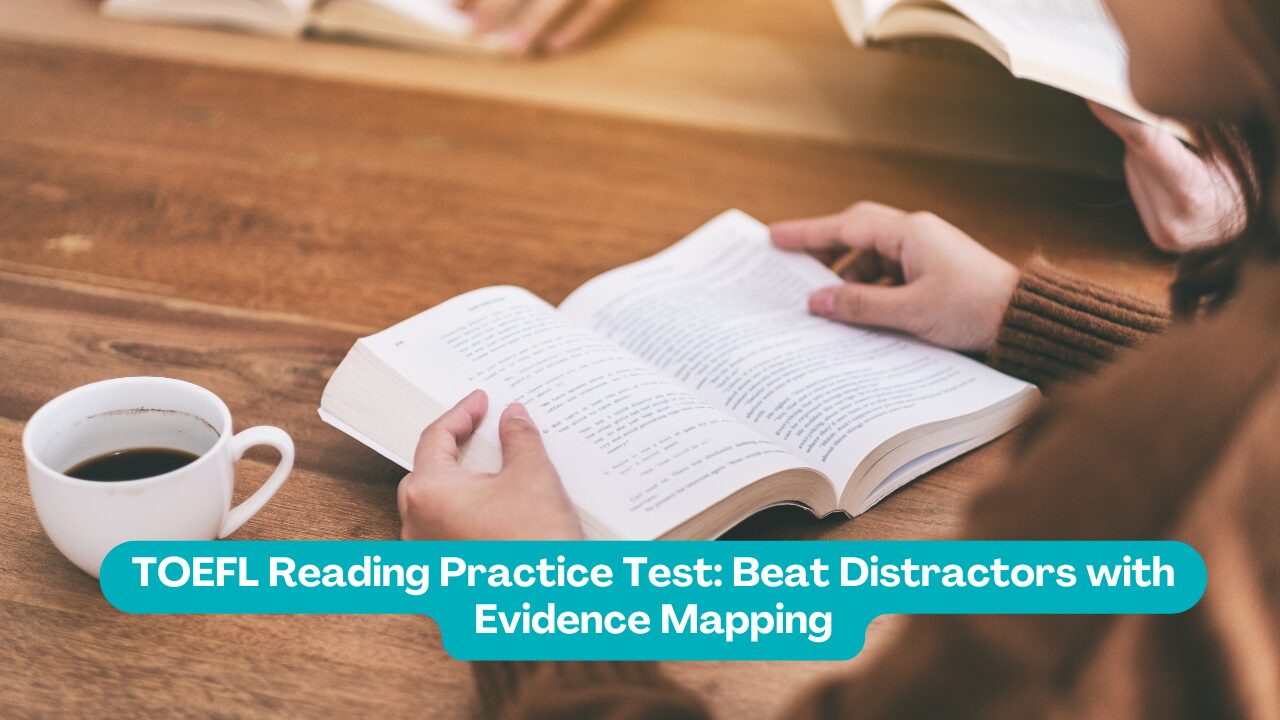
Table of Contents
- Table of Contents
- 1. Understand the TOEFL Reading format in 2025: passages, timing, and scoring
- 2. Core question families: main idea, detail, inference, vocabulary-in-context
- 3. Micro-skimming drills: locating purpose, tone, and paragraph roles quickly
- 4. Evidence mapping: trace lines that prove or disprove tempting choices
- 5. Distractor surgery: patterns of half-true, out-of-scope, and extreme options
- 6. Paraphrase traps: mastering synonyms and idea-equivalence under time pressure
- 7. Summary and table completion: synthesizing key points without overreading
- 8. Adaptive practice sprints: 10–12 minute reps that mirror real test cadence
- 9. Data-driven targets: set reading goals using the latest percentiles and means
- 10. Test-day playbook: pacing, flagging, and final-pass verification routines
- FAQs
- Conclusion
Preparing for the TOEFL Reading Practice Test can be overwhelming — especially with tricky distractors, paraphrase traps, and the constant ticking of the clock. Yet, every challenge in this section can be conquered with a smart, evidence-based approach. As an English Trainer and UGC-NET qualified Assistant Professor, I, Aswathy Mohandas, have guided hundreds of students around the world to achieve their dream TOEFL scores.
The key is understanding how the test works, how distractors are designed to mislead you, and how to build habits like evidence mapping that make you faster and more accurate. In this guide, we’ll break down the latest 2025 TOEFL Reading format, explore question families, and teach you practical drills to beat time pressure while improving comprehension and accuracy.
“Success is where preparation and opportunity meet.” – Bobby Unser
Table of Contents
- Understand the TOEFL Reading format in 2025: passages, timing, and scoring
- Core question families: main idea, detail, inference, vocabulary-in-context
- Micro-skimming drills: locating purpose, tone, and paragraph roles quickly
- Evidence mapping: trace lines that prove or disprove tempting choices
- Distractor surgery: patterns of half-true, out-of-scope, and extreme options
- Paraphrase traps: mastering synonyms and idea-equivalence under time pressure
- Summary and table completion: synthesizing key points without overreading
- Adaptive practice sprints: 10–12 minute reps that mirror real test cadence
- Data-driven targets: set reading goals using the latest percentiles and means
- Test-day playbook: pacing, flagging, and final-pass verification routines
1. Understand the TOEFL Reading format in 2025: passages, timing, and scoring
The 2025 TOEFL Reading section includes 2–3 academic passages, each about 700 words long, with 10 questions per passage. You’ll have a total of 35 minutes to complete the section. Scores range from 0 to 30, based on the number of correct answers.
Key facts:
- 2–3 passages per test
- 10 questions per passage
- 35 minutes total
To get realistic practice, try the Galvanize TOEFL Sample Test. For official details, refer to ETS TOEFL.
2. Core question families: main idea, detail, inference, vocabulary-in-context
TOEFL Reading questions fall into four major types:
- Main idea:Identify the passage’s central message.
- Detail:Find specific data or examples.
- Inference:Draw logical conclusions beyond direct statements.
- Vocabulary-in-context:Understand word meaning within the passage’s tone.
Example:
- Main idea: What is the passage primarily about?
- Detail: Why did the scientist change their hypothesis in paragraph 3?
Tip: When you attempt a TOEFL Reading Practice Test, label each question type to train your brain to apply the right strategy.
3. Micro-skimming drills: locating purpose, tone, and paragraph roles quickly
Micro-skimming means reading selectively to identify the purpose, tone, and structure of each paragraph. It’s an essential skill since TOEFL Reading passages often shift between explanation, comparison, and argument.
Drill:
- Spend 15 seconds per paragraph.
- Note its purpose (introduce, contrast, summarize), tone (neutral, critical, persuasive), and role (main idea, detail, transition).
- Practice this usingGalvanize TOEFL Prep.
This builds the foundation for faster comprehension and higher accuracy under time pressure.
4. Evidence mapping: trace lines that prove or disprove tempting choices
Evidence mapping is one of the most powerful strategies in TOEFL Reading. It means tracing specific lines or sentences that support or contradict each answer choice.
How to do it:
- Read the question carefully.
- Find key terms in the passage.
- Underline sentences that provide direct proof.
- Match each option with evidence—or eliminate it if none exists.
When done consistently, evidence mapping drastically reduces wrong answers caused by half-true or out-of-scope choices.
5. Distractor surgery: patterns of half-true, out-of-scope, and extreme options
Distractors are designed to look tempting but fail under scrutiny. The most common types are:
- Half-true:Partially correct but misses the main idea.
- Out-of-scope:Information not mentioned or irrelevant.
- Extreme:Containing absolute words like “always,” “never,” or “only.”
Strategy:
- Eliminate these by referring back to the text.
- Distrust answers that feel “too strong” or “too general.”
Practicing “distractor surgery” during every TOEFL Reading Practice Test improves both accuracy and confidence.
6. Paraphrase traps: mastering synonyms and idea-equivalence under time pressure
Paraphrase traps appear when test-makers rephrase key ideas with near-synonyms.
How to avoid them:
- Highlight essential words in both the passage and the question.
- Compare meaning carefully — not just vocabulary.
- Ask, “Does this say the same thing, or is it slightly distorted?”
With enough practice through Galvanize TOEFL Prep, you’ll quickly recognize when an answer is a true paraphrase or a twisted one.
7. Summary and table completion: synthesizing key points without overreading
Summary and table completion questions check your ability to combine key information.
Steps:
- Skim topic sentences.
- Identify repeated or emphasized ideas.
- Fill in blanks using facts only from the passage.
The best test-takers summarize precisely—no assumptions, no extra info.
8. Adaptive practice sprints: 10–12 minute reps that mirror real test cadence
Short, timed “sprints” mimic actual exam pressure.
Drill plan:
- Set a 12-minute timer.
- Attempt one passage with 10 questions.
- Review your errors immediately.
Use the Galvanize TOEFL Sample Test for adaptive practice that adjusts to your performance level.
9. Data-driven targets: set reading goals using the latest percentiles and means
According to ETS, a score of 23+ in TOEFL Reading places you in the 75th percentile. Setting data-based goals helps track improvement.
How to apply data:
- Match your score to university requirements.
- Monitor percentile growth, not just raw points.
- Use dashboards likeGalvanize TOEFL Prepto track your stats after each practice test.
10. Test-day playbook: pacing, flagging, and final-pass verification routines
A strong plan on test day can save valuable time.
Playbook:
- Pacing:10 minutes per passage.
- Flagging:Mark tough questions and move on.
- Final pass:Use the last 5 minutes to review flagged questions with evidence mapping.
For last-minute prep, use a Galvanize TOEFL Discount Code for access to premium modules and revision drills.
FAQs
- What is the best way to prepare for the TOEFL Reading Practice Test?Take frequent, timed tests and review errors using evidence mapping. Try
the Galvanize TOEFL Sample Test. - How many questions appear in the Reading section?Typically 20–30 questions (10 per passage).
- Are passages harder than textbooks?No. TOEFL passages are academic but logically structured.
- What score should I target?Aim for 22–26 for top universities.
- How can I improve speed?Practice micro-skimming and adaptive sprints.
- What are common distractors?Half-true, extreme, and irrelevant options.
- Can I change answers during the test?Yes, within the section’s time limit.
- Where can I find free TOEFL Reading tests?Take a
free TOEFL Reading Practice Testor visitETS TOEFL.
Conclusion
Beating the TOEFL Reading Practice Test isn’t about luck—it’s about strategy, timing, and confidence built through deliberate practice. Use evidence mapping to see beyond distractors, micro-skimming to read efficiently, and adaptive sprints to sharpen endurance. Every passage you read brings you closer to mastery.
Remember, preparation is the bridge between where you are and where you want to be. Build that bridge with discipline and data.
Take your free TOEFL Reading Practice Test now and unlock expert feedback!